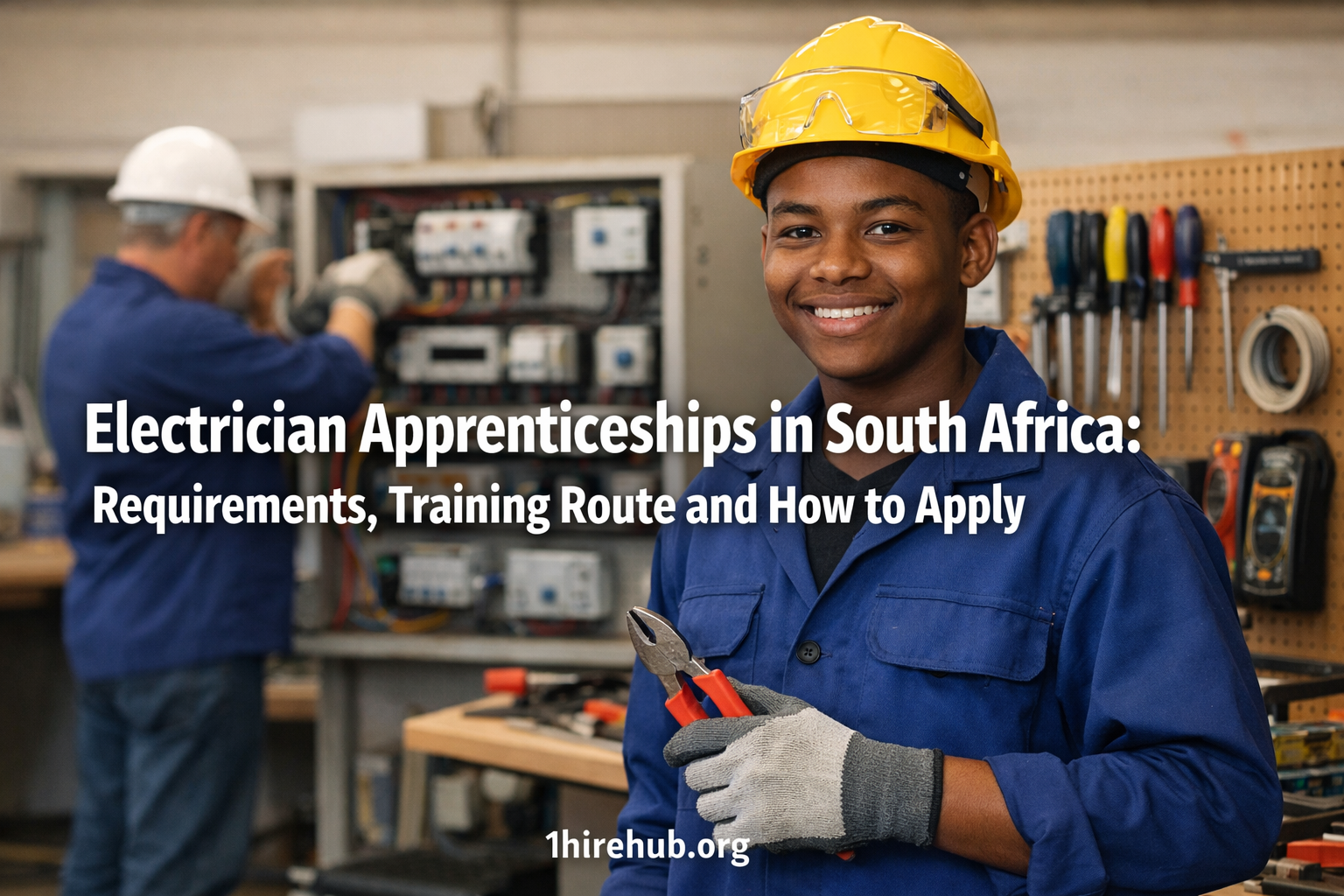
If you want to become an electrician in South Africa, an apprenticeship is one of the main trade routes that can lead to recognised artisan status. This guide explains what the apprenticeship involves, what entry routes may apply, what documents are commonly needed, how the training usually works, and how the route leads toward the trade test.
Electricians are part of the country’s in-demand artisan landscape, and the formal route usually combines theory, practical training, workplace learning, and trade testing under the national artisan system.
What an electrician apprenticeship actually is
An electrician apprenticeship is a structured training route that helps you become a skilled artisan. In plain language, it means you learn by doing real electrical work while also completing the knowledge and practical training needed for the trade.
South Africa’s artisan system does not treat apprenticeship training as only classroom learning. Official artisan guidance explains that the route includes theoretical training, practical workplace learning under supervision, and then a final trade test. After passing the trade test, the learner can qualify as an artisan.
This is important because many people confuse an apprenticeship with a short course. A short electrical course may help you learn basics, but it is not the same as following the recognised artisan route.
Role summary: what an electrician apprentice does
As an apprentice, you are not yet a fully qualified electrician. You work under guidance while building competence.
A typical apprentice may help with:
- preparing tools, materials, and work areas
- assisting with wiring and installation work
- helping connect equipment and control systems
- testing and inspecting installations
- learning how to identify faults
- assisting with maintenance and repairs
- following safety procedures on every task
A recent local-government electrician training notice described the occupation in similar practical terms: learners are trained to plan and prepare worksites, install and connect equipment, test and inspect systems, commission installations, and maintain or repair electrical equipment and control systems.
In everyday terms, that means you are learning how electrical work is done properly from start to finish, not just how to hold tools.
Where apprentices usually work
Electrician apprenticeships in South Africa can appear in different environments. The work setting changes, but the core purpose stays the same.
Common places include municipalities, utilities, manufacturing plants, engineering firms, construction contractors, mines, industrial maintenance teams, and some training partnerships linked to TVET colleges or SETA-supported programmes.
The best mindset is not to search only one employer name. Search by route as well. A municipality, parastatal, contractor, or sector training project may all offer a valid opening if the programme is part of the recognised artisan pathway.
Common entry requirements in South Africa
This is where many applicants get confused, because not every advert uses the exact same wording.
The official artisan portal says an apprenticeship candidate needs at least Grade 9 or an N2 certificate in the trade area, while also noting that historic access routes include Grade 9, academic matric with Mathematics and Physical Science, and technical matric routes.
In practice, current opportunities often ask for more than the absolute minimum. For example, a Garden Route District Municipality electrician training notice required an NQF Level 3 qualification, which is roughly Grade 11, with Mathematics and Science. A Knysna Municipality skills advert listed Electrician with Grade 9 to 12 plus Mathematics and Physical Science.
So the safest way to explain the entry requirements is this:
The minimum route
Some apprenticeship pathways may accept applicants with Grade 9 or a relevant N2 background.
The stronger route
Many employers or funded programmes prefer Grade 11 or Grade 12, especially if you have Mathematics, Physical Science, Engineering Science, or relevant technical subjects.
The practical rule
Always read the advert itself. Never assume one employer’s requirements apply to all.
Subjects and qualities that help
Even when an advert does not make every subject compulsory, some subjects give you a better chance of coping with the work.
These usually include Mathematics, Physical Science, Electrical Technology, Engineering Science, and sometimes technical drawing or related vocational subjects.
Beyond subjects, employers usually value:
- willingness to work with tools and follow instructions
- comfort with practical problem-solving
- reliability and punctuality
- safety awareness
- ability to learn from supervision
- basic communication skills
- readiness to work on sites, in workshops, or outdoors
An electrician apprenticeship is not a desk-only route. It suits people who want practical work and can stay focused when safety matters.
Documents you usually need
This part matters more than many applicants realise. Good candidates still lose out because their application is incomplete.
Based on recent South African training adverts, common documents include:
- a certified copy of your South African ID
- certified copies of your highest qualification or school results
- an updated CV
- proof of address in some cases
- an affidavit about previous experience or past learnerships in some cases
- a completed application form if the employer uses one
- sometimes a criminal clearance certificate before placement begins
For example, Garden Route required a certified ID, certified highest qualification, and an updated CV. Knysna also asked for proof of address, an affidavit on previous work experience or learnerships, and a municipality application form.
Before you apply anywhere, save clean PDF copies of your documents on your phone and email. That alone can make the process much easier.
How the training route usually works
1. You build the theory base
This can happen through a TVET college, technical programme, or another recognised learning route. The artisan portal notes that TVET colleges offer linked qualifications such as NCV and NATED programmes, and EWSETA’s career guide points readers to TVET colleges across South Africa for learnerships, apprenticeships, and related programmes.
2. You get contracted or placed for workplace learning
The apprenticeship system is designed around real workplace exposure. NADSC’s “7 steps” material says the majority of artisan learning happens in the workplace, where apprentices apply theory and practice in real settings.
3. You complete knowledge, practical and workplace training
This is the heart of the process. You do not become employable by theory alone. You need repeated exposure to real tasks, real standards, and real supervision.
4. You gain access to the trade test
The apprenticeship route includes trade testing. Official artisan guidance explains that once the learner has enough on-the-job training and theoretical knowledge, they gain access to do a trade test.
5. You are certified
QCTO explains that after a candidate passes a trade test, the documents move from the trade test centre to the relevant SETA, then to NAMB, and then to QCTO for the trade certificate to be issued.
How long does it take?
Government artisan guidance describes an artisan as someone trained through a 4-year apprenticeship. The artisan portal also says apprenticeship duration can vary from about 18 to 36 months before trade test access, while some local occupational electrician programmes are advertised as 3 years.
The honest answer is that the timeline depends on the route, the programme design, and how quickly your knowledge, workplace exposure, and assessments line up. So do not choose an opportunity just because it sounds faster. Choose one that is legitimate and clearly connected to recognised training and testing.
Where to find electrician apprenticeships
The best search strategy is broader than just typing one phrase into Google.
Start with these route types:
Municipal and public-sector opportunities
Municipalities sometimes advertise artisan development or skills programmes that include electrician training.
TVET-linked opportunities
Check nearby TVET colleges and follow their notices, partnerships, and student support offices.
SETA-linked programmes
Electrician opportunities may appear through sector-linked training or employer partnerships. EWSETA is relevant for parts of the energy and water space, while local-government training projects may involve LGSETA support.
Employer career pages
Look at utilities, engineering companies, contractors, manufacturing firms, mines, and infrastructure companies.
Official artisan system resources
Use the DHET artisan portal to understand the pathway and to identify accredited routes, skills development providers, and trade test centres. NADSC also provides trade test centre listings, and the centre search includes Electrician across many towns and provinces.
A practical checklist before you submit
Use this short checklist before every application:
- Is the employer or training body clearly identified?
- Did you read the minimum requirements properly?
- Are your documents clear and certified where needed?
- Is your CV updated?
- Did you use the correct reference number?
- Did you submit before the deadline?
- Did you keep proof of submission?
That checklist sounds basic, but it prevents many avoidable mistakes.
Scam warning: how to stay safe
This niche attracts scams because many young job seekers are desperate for artisan opportunities.
Be careful if someone:
- asks for payment to secure an apprenticeship
- promises guaranteed placement without formal process
- uses a free email address with no clear employer identity
- gives no official advert, reference number, or application route
- asks for banking details too early
- avoids proper interviews, assessment, or documentation
A real apprenticeship may include forms, screenings, interviews, assessments, and certified documents. That can feel slow, but it is normal. What is not normal is being told to pay to be shortlisted.
Stick to official employer pages, municipal notices, known training bodies, and recognised artisan system resources where possible.
What happens after qualifying?
After you complete the route and pass the trade test, you are in a much stronger position than someone with only informal exposure.
You may then pursue work in installation, maintenance, industrial operations, utilities, construction support, facilities management, manufacturing, mining, or contractor teams. Some qualified electricians later specialise further, move into inspection or supervision, or build experience toward registration and compliance-related roles.
The apprenticeship is not the finish line. It is the foundation.
FAQ
Do I need matric to apply for an electrician apprenticeship in South Africa?
Not always. The artisan system recognises routes that can start from Grade 9 or a relevant N2 background, but many real opportunities prefer Grade 11 or Grade 12, especially with Mathematics and Science. Always check the advert instead of guessing.
Is an electrician apprenticeship the same as a learnership?
Not exactly. The terms are sometimes used loosely in public adverts, but an apprenticeship is a trade-focused learning route that includes workplace learning and leads toward a trade test. Official artisan guidance treats apprenticeships and learnerships as related but distinct pathways.
How long does an electrician apprenticeship take?
It depends on the route. Some official guidance describes a 4-year artisan apprenticeship, while some advertised occupational electrician programmes are around 3 years. The timeline varies according to the programme and training pathway.
What documents do I need to apply?
You will usually need a certified ID, certified qualifications or school results, and an updated CV. Some programmes also ask for proof of address, affidavits, forms, or later-stage clearance documents.
Where can I look for legitimate electrician apprenticeship opportunities?
Look at municipal notices, employer career pages, TVET-linked opportunities, SETA-related programmes, and the DHET artisan system resources. The NADSC platform also points users to accredited centres and trade test routes.
Do electrician apprentices get paid?
Some programmes offer stipends or training support, but not every opportunity is structured the same way. For example, Garden Route’s local-government training notice stated that stipends would be paid to trainees through LGSETA.
Can I become an electrician through only a short course?
A short course can help with basic skills, but it is not the same as completing the recognised artisan route. For long-term credibility and better job prospects, the apprenticeship and trade test pathway is the stronger option.
What is the trade test?
It is the final practical assessment that forms part of the artisan pathway. After passing it, the candidate’s documents move through the official certification process so that QCTO can issue the trade certificate.
Conclusion
Electrician apprenticeships in South Africa are best understood as a real training route, not a shortcut. You learn theory, gain practical exposure, work under supervision, and move toward trade testing.
That makes this path demanding, but it also makes it valuable.
If you are serious about becoming an electrician, focus on the basics first. Build your documents properly. Watch for legitimate opportunities. Read every advert carefully. Strengthen your maths, science, and technical foundation where possible. Then apply consistently and patiently.
A clear, recognised route will usually take you further than rushing after anything that simply says “electrical job” online.